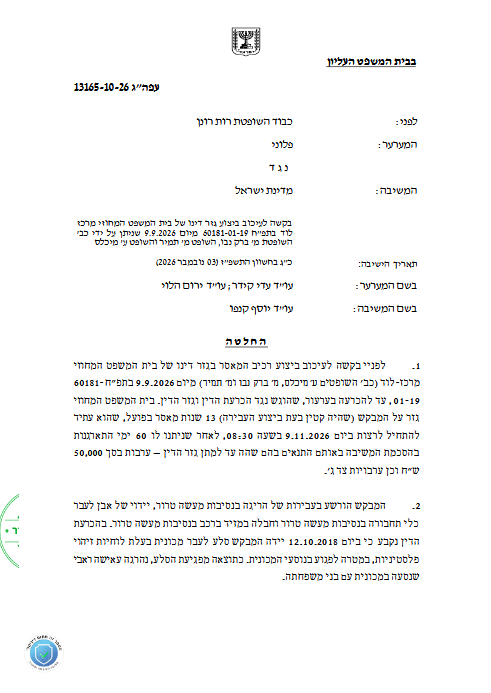
First page of Justice Ronen’s decision
Monday, November 3, 2026, 20:47 In October 2018 the A-Rabi family was driving on Highway 60 in the Shomron, near Tapuah Junction, when their car was hit by a stone. In September 2026, the Central District Court in Lod convicted T., a Binyamin resident who was a minor at the time of the incident of killing of Aisha al-Rabi. He was convicted by a majority of two judges to one and sentenced to 13 years in prison.
Honenu Attorneys Yarom Halevi and Adi Keidar are representing T., who was scheduled to begin serving his sentence next week. In a request filed with the Supreme Court to delay his entry into prison, the attorneys argued that there is no reason for him to begin serving the sentence while he appeals both the conviction and the sentence, especially given the high chances of success on appeal. They noted that the conviction rests on disputed circumstantial evidence and that T. has no criminal record.
Justice Ruth Ronen stated: “If his appeal is accepted and he is acquitted, he will not have to serve any prison sentence at all. Therefore, if he is sent to prison before the appeal is heard, he may end up serving time for nothing.”
In her ruling, Justice Ronen held that the request should be granted and described the case as exceptional: “The applicant’s conviction in the district court was based on circumstantial evidence. As was made clear, one of the judges on the panel believed that this evidence was insufficient to justify a conviction and that the applicant should be acquitted on the basis of reasonable doubt.”
She further noted that the applicant had not violated the terms of his release during the entire eight-year proceedings, had not become involved in any criminal matters, and had no prior criminal record. Finally, Justice Ronen ruled that “the harm that would be caused to the applicant if he begins serving a prison sentence and is ultimately acquitted outweighs the public interest in having him begin serving his sentence immediately.” She ordered a stay of the prison sentence pending the decision on the appeal.
Attorneys Halevi and Keidar stated: “We welcome the court’s decision to stay the prison sentence and are confident that this is the first step toward the appellant’s full acquittal. This is a precedent-setting decision that relies on the exceptional district court ruling, in which the judges were divided and the presiding judge chose to acquit the defendant. We hope the Supreme Court justices will have the courage to adopt the acquitting opinion, order the appellant’s full acquittal, and allow him to begin his life after an eight-year legal battle.”