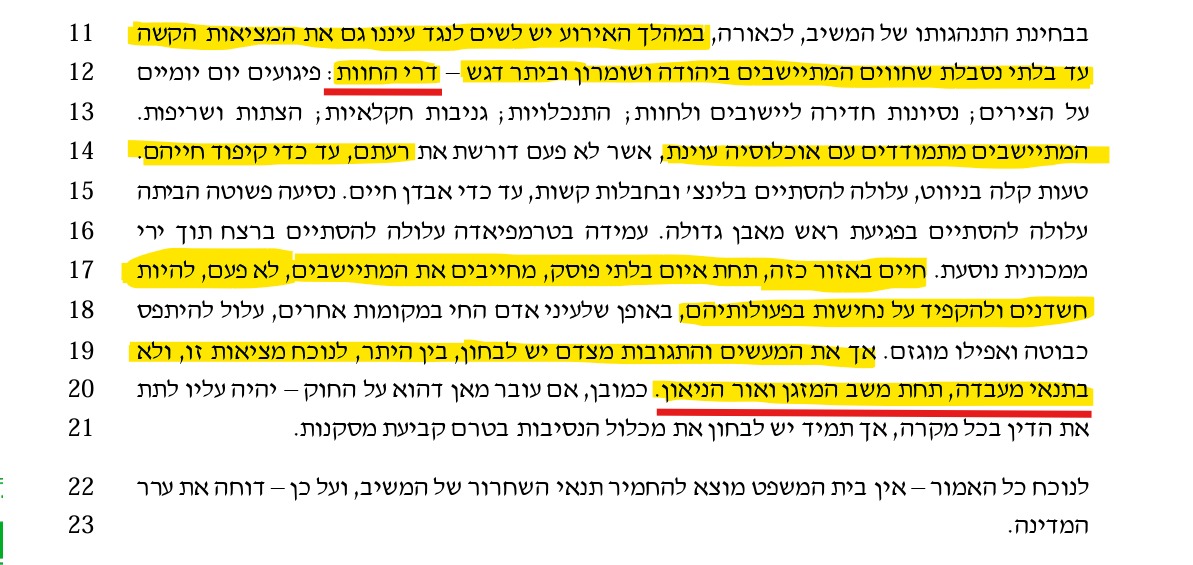
Segment of Judge Sulkin’s decision
Tuesday, July 21, 2026, 15:18 The Central District Court has issued unusual criticism of the Israel Police and the office of the State Attorney’s handling of a case against a Jewish farm-owning Shomron resident. Judge Ron Sulkin rejected the state’s appeal seeking harsher release conditions and described the harsh reality faced by Jewish farmers and other residents of Yehuda and Shomron confronting terrorism in general and agricultural terrorism in particular. He ruled that “we must also keep before our eyes the difficult, even unbearable, reality experienced by the settlers in Yehuda and Shomron, and especially by farm residents,” rather than judging them under “laboratory conditions.”
The Central District Court in Lod issued the decision in an appeal filed by the State of Israel against the release conditions of Uriya Cohen, the owner of Havat Tzafnat. The court rejected the state’s appeal, partially accepted an appeal filed by Honenu Attorney Adi Keidar, and leveled unusually sharp criticism at the police and State Attorney’s office for their conduct toward Jewish farmers and other residents of Yehuda and Shomron.
Among other remarks, Judge Sulkin wrote of “the difficult, even unbearable, reality experienced by the settlers in Yehuda and Shomron, and with greater emphasis — the residents of the farms,” in the face of terrorism and agricultural terrorism. He criticized law-enforcement authorities, stating that the settlers’ actions “must be examined, among other things, in light of this reality, and not under laboratory conditions, under the air-conditioner’s breeze and neon light.”
In his detailed decision, Judge Sulkin reviewed the course of the case, the events, the parties’ arguments, and the evidence. He described the farm owner’s confrontation on the morning of the incident with the theft of his herd: “Agricultural theft of livestock causes a farmer enormous damage. A herd nurtured for years, into which great effort and substantial money have been invested, disappears in an instant. Insurance companies no longer insure flocks of sheep and cattle, neither in Yehuda and Shomron nor elsewhere. The disappearance of such a herd requires immediate action to locate it, because within a few hours it may be slaughtered or absorbed into other herds. This too is a circumstance that must be taken into account when examining the respondent’s conduct.”
The judge continued: “When examining the respondent’s alleged conduct during the incident, we must also keep before our eyes the difficult, even unbearable, reality experienced by the settlers in Yehuda and Shomron, and especially by farm residents: daily attacks on the roads; attempts to infiltrate communities and farms; harassment; agricultural thefts; arson and fires. The settlers confront a hostile population that not infrequently seeks their harm, even to the point of endangering their lives. A slight navigational error can end in an ambush and serious injuries, or even loss of life. A simple drive home can end with a head injury from a large rock. Standing at a hitchhiking post can end in murder by shooting from a passing car.
“Living in such an area under constant threat often requires settlers to be suspicious and to act with determination in ways that, to someone living elsewhere, may appear harsh or even excessive. But their actions and reactions must be examined, among other things, in light of this reality — not under laboratory conditions, under the air-conditioner’s breeze and neon light. Of course, anyone who violates the law must answer for it. Yet the full range of circumstances must always be examined before drawing conclusions.”
In light of these considerations, the judge found no reason to impose harsher release conditions on Cohen. He rejected the State Attorney’s appeal and partially accepted Honenu’s appeal, shortening the period of Cohen’s driver’s-license suspension.
Honenu Attorney Adi Keidar, who is representing Cohen, responded: “I welcome the District Court’s decision. Judge Sulkin accepted all of our arguments and made very important determinations regarding the situation in Yehuda and Shomron and the attitude toward the residents. I hope the State Attorney’s office and the Israel Police will read the decision carefully, and that its contents will filter down to the last policeman in the field. Uriya Cohen and his friends are pioneers, and that is how they should be viewed — not as criminals.”
Uriya Cohen, the owner of Havat Tzafnat in the Shomron, was arrested after an incident that occurred while searching for a herd stolen from the farm. Cohen, together with IDF forces and other local Jewish residents, went looking for the herd, which according to the findings had been taken to the Arab town of Hawara. There the searchers encountered a terrorist who threatened them with a knife and other weapons. Cohen fired a single shot into the air from his weapon to protect himself and those around him.
An indictment and a request for detention until the end of proceedings were filed against him. The Magistrates’ Court rejected the detention request and released him. The Central District Court has now also rejected the police’s appeal, and the burdensome release conditions against Cohen have been lifted.